

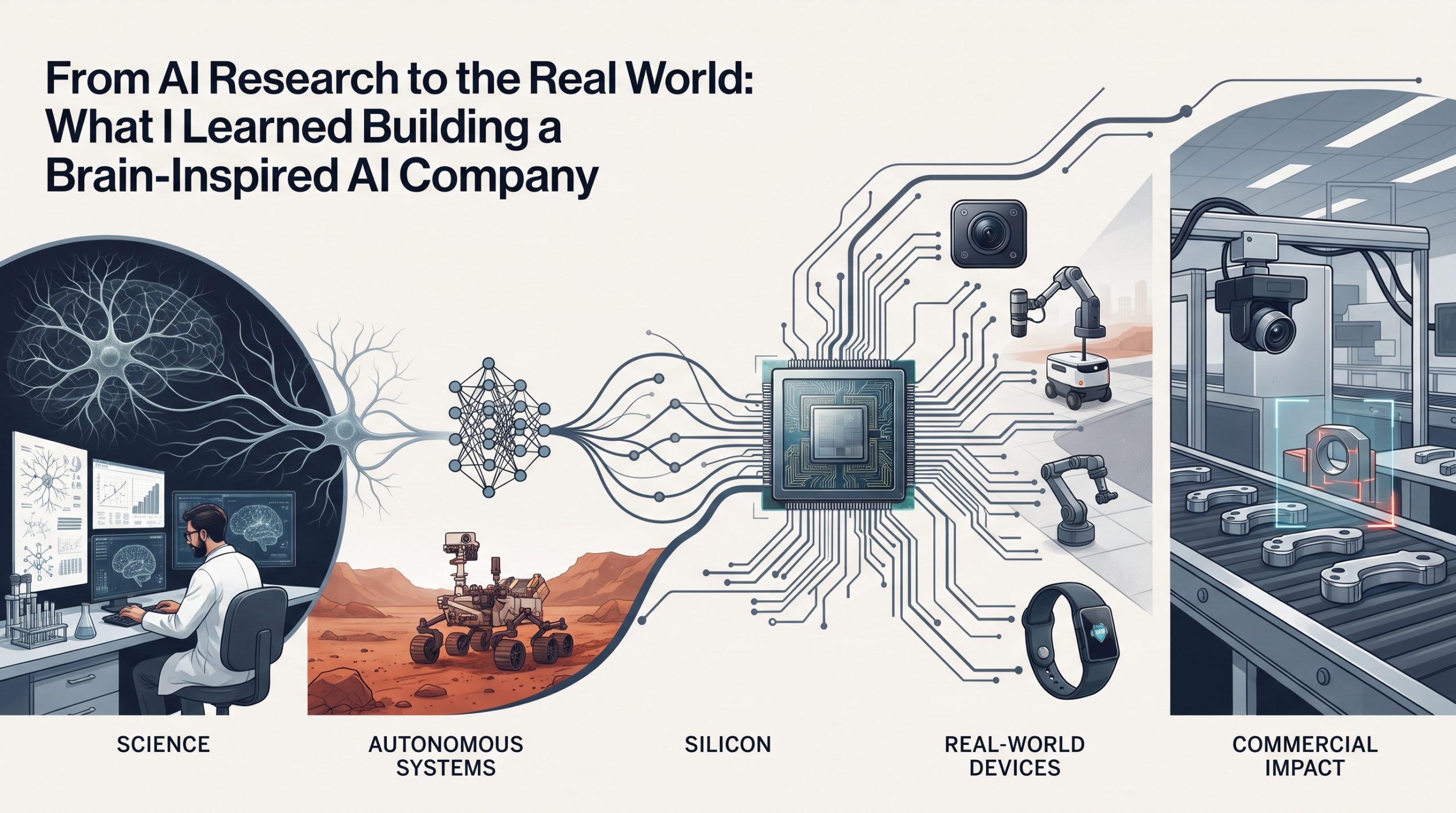
From AI Research to the Real World: What I Learned Building a Brain-Inspired AI Company
There is a peculiar moment in the life of a technology when it has to leave the protected environment of the laboratory and confront the real world, which, as anyone who has spent time doing experiments knows, has the unfortunate habit of refusing to behave according to the assumptions written in the proposal.
I spent the first part of my career as a scientist working on artificial intelligence, neural networks and computational neuroscience, and for many years I was interested in questions that were fundamentally scientific: how does the brain learn continuously, how does it preserve useful information without constantly retraining itself, how can a biological system process an enormous amount of sensory information while consuming very little energy, and what, if anything, can we borrow from biology to design better artificial systems?
These questions eventually led me, together with my co-founders, to Neurala, and with Neurala came a very different type of education.
Over almost two decades, I went from working on computational models and neuromorphic systems to building a venture-backed AI company, raising more than $30 million, hiring scientists and engineers, developing intellectual property, working with organizations such as DARPA and NASA, partnering with semiconductor companies, selling into large enterprises, and seeing our technology deployed in tens of millions of devices. This journey changed the way I think about innovation because I gradually understood that building an AI algorithm and building an AI company are not two stages of the same activity; they are two related but profoundly different disciplines, and success in one does not guarantee success in the other.
When the laboratory ends, reality begins
A research environment gives you the luxury of defining the problem with a certain precision. You decide what data to use, what hardware to run on, what metric matters, how long the experiment can take, and what constitutes an interesting result. In the real world, these conditions disappear very quickly, because a product does not live inside a paper and a customer does not organize the environment around the convenience of your model.
A robot has a battery, a camera has a limited processor, a factory has machines that cannot be stopped every time software needs attention, an industrial customer may not want sensitive images leaving the facility, and a consumer device has cost constraints that can make even a technically elegant solution completely impractical. Then there are all the little details that rarely make it into academic benchmarks: lighting changes, sensors age, machines vibrate, operators move things, networks disappear, components are replaced, and the physical world behaves in ways that make every dataset look wonderfully disciplined by comparison.
Some of my earliest thinking about these constraints came from autonomous systems and from work connected with NASA and DARPA. If you imagine a machine operating in an environment such as Mars, the architectural problem becomes very clear because communication cannot be treated as an invisible assumption. The system has to perceive its environment, extract useful information, make decisions and, ideally, adapt locally rather than depending on a large remote computing infrastructure.
Years later, when Neurala began working in industrial environments, embedded devices, cameras and robotics, I found it amusing that many of the same constraints appeared again in completely different clothes. A factory floor is obviously not Mars, although some factories at three in the morning can feel surprisingly close, but the underlying computational requirements often have much in common: limited resources, imperfect connectivity, the need for local decisions, changing conditions and a requirement that the system continue to operate even when the world does not cooperate.
This was one of the first major lessons I learned about commercialization. A technology is often born inside one problem, while its most valuable market may appear somewhere else, and the difficult part is understanding which element of the original invention is truly fundamental and which part is only an artifact of the first application.
Customers have a very healthy lack of interest in your neural network
Researchers naturally become attached to mechanisms because mechanisms are what we study. We care about learning rules, architectures, representations, optimization, memory, sparsity, efficiency and all the other elements that make a system technically interesting. Customers, on the other hand, tend to approach the same technology with a refreshingly different perspective.
A manufacturer with defective products leaving a production line does not care whether the neural architecture is elegant; he wants fewer defects to leave the factory. A robotics company cares that the machine responds within a required latency. A semiconductor company wants to know whether an algorithm can run efficiently on the silicon they are building. A camera manufacturer may care whether intelligence can remain inside the device instead of pushing everything into the cloud.
This sounds trivial when written afterwards, but for a technical founder it requires a real change in thinking because we spend many years becoming experts in the solution and then discover that the market judges us almost entirely by the quality of the problem we solve.
At Neurala, our technology moved across robotics, drones, consumer electronics, embedded systems and eventually industrial automation, while some of the deeper technological ideas remained remarkably consistent. The commercial expression changed because the customer changed, and this forced us to learn how to describe the same underlying capabilities in very different terms.
What I came to understand is that a technology company cannot remain in love with the vocabulary of its invention. At some point, the company must become fluent in the vocabulary of the customer.
AI eventually meets physics
Another recurring theme throughout my career has been the relationship between algorithms and the hardware on which those algorithms must run.
In software, it is tempting to think of hardware as something that sits underneath the interesting part of the problem, almost as if computation were an infinite and neutral resource. This assumption can survive for a while in the cloud, especially when budgets are generous, but it collapses very quickly once AI enters the physical world.
Memory consumption influences hardware choice. Hardware choice influences power. Power influences thermal design. Thermal design affects cost and reliability. Latency determines whether the application is usable. Training requirements influence deployment time. Privacy requirements determine whether the data can leave the device at all. What begins as an algorithmic decision quickly becomes a product decision, and what begins as a product decision eventually becomes a business decision.
During the history of Neurala, we worked with companies including Qualcomm, Sony Semiconductor Solutions, Movidius, Lattice Semiconductor and others, and through these collaborations I became increasingly convinced that hardware/software co-design is not merely an engineering optimization; in many AI applications, it is part of the commercial strategy.
If the AI capability can run on hardware already present in the customer’s system, deployment may be simple and economics attractive. If the solution requires a new board, additional memory, active cooling, a different processor and six months of integration work, the technical improvement has to be sufficiently important to justify all of those additional costs.
I have seen very good algorithms lose this argument.
The lesson is not that accuracy does not matter, because obviously it does; the lesson is that an AI product is evaluated as a system, and a system is constrained by physics, economics and the practical realities of deployment. Eventually, the model has to run somewhere, on something, for somebody who is paying for the privilege.
The strange transition from research capital to venture capital
The way technology is funded also changes the questions that surround it.
Some of our early work was supported by research programs involving DARPA, NASA, the Air Force and other organizations that were willing to fund difficult technical problems long before there was an obvious commercial market. This type of funding plays an essential role in deep technology because truly new capabilities often require years of work before anybody can predict which market will emerge around them.
Research programs can ask questions such as whether a machine can learn autonomously, whether neural computation can be made dramatically more efficient, or whether an autonomous system can operate under severe resource constraints. These are excellent questions, and they may eventually create enormous commercial value, but at the beginning the connection is often not obvious.
Then, if you are building a company, a different set of questions begins to appear.
Who will pay for this?
How large is the market?
What is the sales cycle?
How defensible is the technology?
How much capital is required before the product reaches scale?
When Neurala moved into venture financing and ultimately raised more than $30 million, I had to become comfortable living between these two worlds. The scientist in me wanted to discuss the technical significance of the architecture, while the CEO had to explain why the technology mattered economically, why the company was defensible, and why the market would become large enough to justify the investment.
This was one of the most useful parts of becoming an entrepreneur because it forced me to understand that scientific evidence and business evidence are related but different. A scientifically convincing result can still support a poor business, while a large market opportunity is useless if the technology does not work.
The company has to make both arguments simultaneously.
Intellectual property and the problem of ideas that become obvious later
Another aspect of deep technology that I learned to appreciate over time is intellectual property.
When you work on ideas before they become fashionable, there is often a strange sequence of reactions. At first, people ask why anybody would care. Later, when the field becomes important, some of the same ideas begin to look so natural that people ask how they could ever have been considered novel.
This is not unusual in technology.
We filed patents around neural computation, AI acceleration and related approaches during periods when these topics attracted considerably less attention than they do today, and the experience taught me that IP strategy cannot be treated as an administrative activity that happens after the interesting work is finished.
At the same time, I have never believed that patents alone create a meaningful company. A patent without product, customers, execution or a commercial strategy is still only a legal document. The useful question is therefore not simply whether something can be patented, but whether the company understands what part of its technical advantage will continue to matter if the technology succeeds.
Sometimes that advantage comes from patents. Sometimes it comes from software, deployment know-how, trade secrets, proprietary data, relationships, ecosystem position or the accumulated knowledge of a team that has solved the same problem many times.
Usually, the moat is less elegant and more complicated than the slide describing it.
This is another difference between research and company building. In research, novelty may be enough to justify the work; in business, novelty has to be connected to value that the company can retain.
The founder gradually becomes a translator
When a technical company is very small, the founders often know almost everything about the technology because they created most of it. This is comforting, but fortunately it does not last.
If the company grows properly, you begin hiring people who understand specific parts of the system far better than you do. Someone understands the compiler better, someone understands the architecture better, someone knows the customer’s production environment better, someone knows the semiconductor platform better, and someone, usually in finance, understands the spreadsheet in a way that you are very happy to leave to them.
The founder’s role changes.
For me, one of the most important parts of being CEO became translation across groups that were all essential to the company but naturally spoke different languages.
A scientist might explain why a learning mechanism was fundamentally different. An engineer would explain why the mechanism was difficult to deploy on a particular processor. A customer would explain that the entire project had to work within three weeks because a production line was changing. An investor would ask whether the resulting market could support a large company. The board would want to understand what all of this meant for strategy and capital.
They were all talking about the same company, but not always about the same thing.
Over time, I began to see company building as another form of systems engineering. Technology affects product, product affects sales, sales influence capital requirements, capital determines hiring, hiring changes what the company can build, partnerships affect distribution, distribution influences the roadmap, and the roadmap eventually comes back to the technology.
Perhaps because of my background in neuroscience, this interconnected picture always made intuitive sense to me. Biological systems rarely work through one component commanding all the others; intelligence emerges from interaction, feedback, adaptation and specialization.
Companies are not so different.
From Mars to manufacturing, with several detours in between
One of my favorite parts of the Neurala story is the path from research on autonomous systems to industrial visual inspection.
If someone had shown me the complete sequence at the beginning, I would probably have considered it a rather creative piece of storytelling. In reality, innovation often develops exactly this way because the underlying capability survives while the market around it changes.
Our early work explored systems that could perceive and learn under constraints. Much later, manufacturers needed systems that could learn visual defects with relatively limited data, operate efficiently, remain close to the production environment and adapt to changes on the factory floor.
The commercial context was very different, yet many of the underlying technical principles felt familiar.
This eventually contributed to Neurala’s work in visual inspection for manufacturing, where technology rooted in research on autonomous systems found a very practical application in identifying anomalies and defects in production.
People often describe commercialization with a neat arrow that goes from research to product to market.
My experience has been much less linear.
It resembles driving through Rome during rush hour: there is a destination, there are rules in theory, everybody appears to understand them differently, and somehow movement continues.
The important thing is that the direction survives the detours.
What science taught me about running a company
The similarity between science and entrepreneurship that I value most is the requirement to remain committed to the question without becoming too attached to a particular answer.
A scientist forms a hypothesis, designs an experiment and then has to accept whatever the experiment says. If the result contradicts the hypothesis, the scientist is expected to change his mind. This can be emotionally inconvenient, but it is the essence of the process.
A company faces the same discipline.
A product can fail. A market may develop more slowly than expected. A customer segment that looks very attractive in a presentation may prove impossible to sell into. The technology can work while the business model does not. The business model can look wonderful while the technology refuses to scale.
The company has to absorb this information and adapt.
During the years I led Neurala, our products changed, our markets changed and the AI industry around us transformed almost beyond recognition, but the deeper questions remained surprisingly stable: how can artificial systems learn efficiently, how can they adapt over time, how can intelligence operate closer to the physical world, and how can ideas from neuroscience and machine learning become genuinely useful?
The word “useful” has always mattered to me.
I love research, and I still enjoy scientific discussions probably more than is reasonable for someone who has spent so much time running companies. But there is a particular satisfaction in watching an idea complete the entire journey from scientific intuition to mathematical model, from model to software, from software to silicon, and from silicon into a product that somebody uses to solve a problem.
At that point, something important has happened.
The technology has stopped being interesting only to the people who invented it.
It has entered the real world, with all the constraints, imperfections, customers, budgets, deadlines and surprises that come with it.
Read more about Max Versace
And for me, that has always been the most interesting experiment of all.