


Title
Two decades ago, AI was not really a market. It was barely a pitch deck, let alone a product roadmap. AI was still mostly confined to academic research, and among the best places to carry out such “fringe” work was the Department of Cognitive and Neural Systems at Boston University. That unique department contained a true singularity: dedicated individuals from the most diverse backgrounds you could imagine, all focused on understanding how brains work and how to translate that understanding into algorithms, hardware and, one day, technology.
In that environment, three PhD trajectories collided: mine, Anatoli Gorchet’s and Heather Ames’s. Out of that collision (and our very practical need to graduate!!) an idea for a company was born, one that could commercialize brain-inspired technology into AI-powered products available to everyone. AI that was adaptable like biological brains, able to learn continuously as we do, adapt on the fly and operate on small-footprint compute power. We wanted machines that behaved a bit more like living brains.
The early days were filled with hard questions. Can we build AI that does not need to ping the cloud every time it encounters something new? Can we align AI models with the messy, continuous nature of biological intelligence rather than with clean, static datasets? Those questions would become the backbone of what later became Neurala and the “Neurala Brain.”

The Space Technology Hall of Fame recognizes technologies that emerged from space programs and then proved their value on Earth. We in great company! Some of the most transformational technologies induced are GPS for redefining global navigation and logistics, active pixel sensors powering smartphone cameras and medical imaging, and memory foam which… all of us know, makes us sleep better! It is an honor to be recognized alongside innovators and innovations that improve in practical ways how we live our lives.
To the best of my knowledge, this is the 1st award to AI technology given by the Space Technology Hall of Fame.

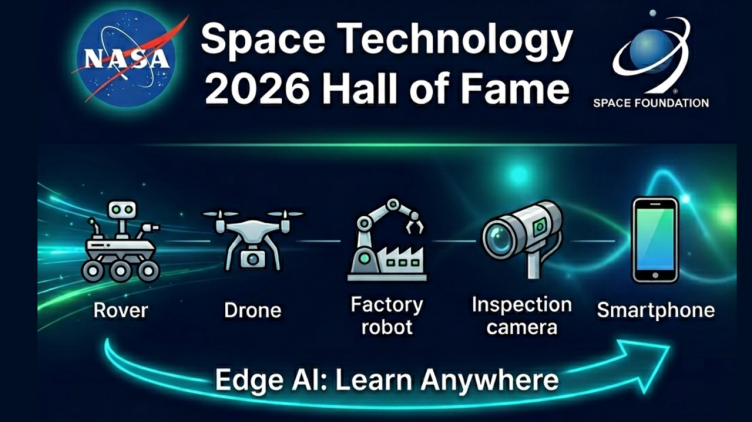
In our case, that translation of invention to practical use was unexpected at best. We started from “robot brains” for Mars-rover–class robots that needed to navigate and learn their surroundings using very little processing power, and we extended that work to enable NASA drones to avoid potential collisions in the air with AI running entirely onboard. Over time, this journey took us from space to the factory floor, from ground robots to drones to smartphones and inspection lines, through a multi‑year collaboration with NASA Langley Research Center that helped shape both the commercial products and the core technology.
At Langley, Dr. Mark Motter saw in our work something useful for autonomous exploration: the ability for a system to learn new terrain, detect anomalies and adapt without relying on constant connectivity or pre‑labeled, exhaustive datasets. NASA’s support helped push Neurala Brain from academic prototypes to commercially deployable technology, while still allowing Neurala to productize the core ideas. This is exactly the pattern the Hall of Fame is meant to celebrate: space‑driven innovation that becomes an everyday utility.

Once Neurala Brain “graduated” from the lab and the Langley testbeds, it started to travel into unexpected bodies, guided by customer needs. The same principles that made sense for exploration robots, namely, learning on the edge, continuous adaptation, operation under resource constraints, turned out to be powerful for use cases down to Earth. Over time, Neurala’s AI has been deployed in approximately 80 million systems worldwide, operating entirely on‑device. This breed of AI has powered autonomous and semi‑autonomous robotics, smartphone applications with embedded computer vision, consumer and industrial drones (and even using drones to prevent poaching…) and industrial inspection systems that can learn new visual concepts in minutes rather than weeks.

In manufacturing, for example, the same capacity to detect “something new” in a planetary landscape translates into detecting a new kind of defect on a production line. Instead of shipping data to a distant data center, retraining for weeks and redeploying, Neurala Brain was designed to adapt at the edge, under real operational conditions. While that behavior is intuitive and expected for biological intelligence, the technical innovation was very hard. Reducing reliance on massive, static training pipelines and increasing the system’s ability to learn continuously, at the very place where the data is generated, were at the time (and still are today) very hard AI problems to solve!
Awards like this highlight technologies, but behind each technology are people and, often, a long arc of immigration (2/3 of Neurala’s co-founders came from far away!). When I left Italy for the United States with a Fulbright Fellowship, I certainly did not have “Hall of Fame” in mind, but just a large suitcase full of passion for understanding how brains compute and the hope that this knowledge could eventually be translated into something practical.
The early years and our innovations were not a straight line. Looking back from this Hall of Fame announcement, I see less a single breakthrough and more a chain of compounding decisions motivated by ‘gut feelings’ more than hard science, at times. Choosing to focus on edge, continuous learning on small devices when the comfort and immense resources of cloud AI was fashionable, choosing neuromorphic ideas when they were still considered fringe, and choosing to work with agencies like NASA that demand rigor and real‑world robustness.
Today, this recognition matters because it validates a thesis that has been guiding my work for years: the best AI is not built in isolation from the physical world. It emerges when we let the constraints of reality be part of the equation: power budgets, latency, autonomy, safety. Space exploration is perhaps the extreme, hardest version of that reality. You are very alone on Mars, and if your system fails or you need to learn something new and adapt, you cannot reboot it from a data center or send AI workloads to the cloud. It needs to be robust, adaptive and efficient by design.
That same mindset drives my work in emergent AI and physical intelligence today, pushing the boundaries of what AI can do in the physical world to make it safer and more productive.