

Written when I was CEO of Neurala.
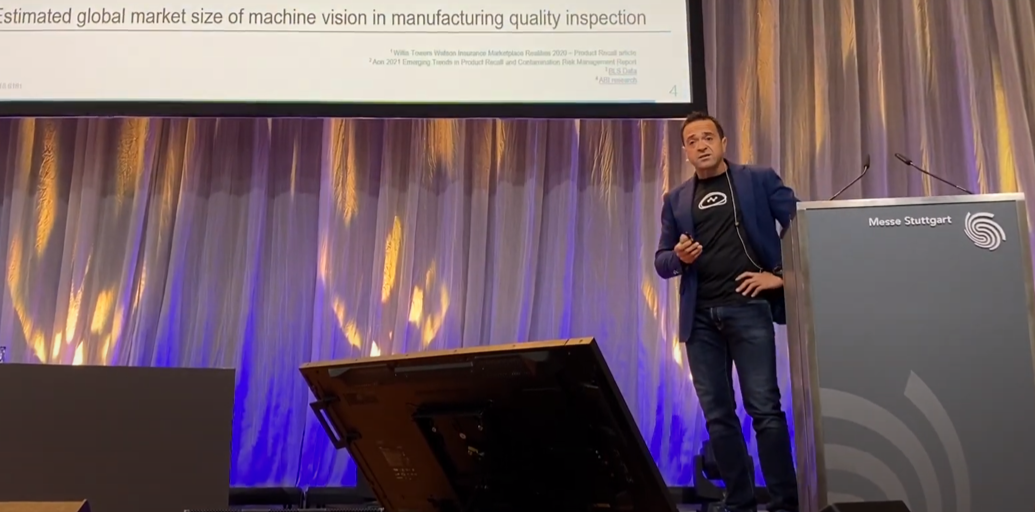
About this recording. “Neurala Max Versace at Industrial VISION Days at Messe, Stuttgart.”, 20 minutes, published on YouTube on 21 October 2022. Watch it on YouTube.
Edited transcript
Cleaned up from the automatic captions and shortened. Cuts are marked […]. For the exact words, watch the video.
Thank you so much. Can you hear me? We are going to talk about deep learning today.
If you read the news about our industry, you find supply chain disruption, the pandemic boosting automation and robotics. You would think that is all there is. But the challenges in manufacturing are much older. The pressure to improve has always been there. Reshoring is a more recent tendency, with factories coming back to the US and Europe. The number of products keeps growing, and that adds complexity. […]
Let’s talk about one specific task: visual inspection. Quality inspection is checking whether the product is right or not. […] The inspection workforce is shrinking, and it is being met by adding more and more automation. That is where deep learning comes in.
The brain up there on the slide is what I have been working on for about 25 years, at the beginning in academia, now with my own software company. […] We are moving from each camera, or each machine, needing a human operator to understand what is going on, to a scenario where each camera and each machine has its own brain. That comes from the research people like myself have done for the past 20 or 30 years. It gives the camera the ability to learn from examples, like we do. I show you a chair, I tell you it is a chair, and you learn it very quickly without much supervision.
What is the difference between traditional machine vision and deep learning? Deep learning is a new word for a very old technology called neural networks. When I joined the field, deep learning did not exist as a name. In traditional machine vision you use the intelligence of the operator to create a sort of flowchart, based on explicit features that somebody programs, to say this cap is defective or not. In neural networks, the intelligence of the scientist is in the equations that describe the relationship between neurons and synapses, and the system learns by itself to tell a good cap from a bad one. It is a data-driven approach. That is the fundamental difference.
We started with inspection 1.0, the manual one, with an operator looking at products. It is expensive, inconsistent, it cannot see defects invisible to the human eye, and it leaves no trace. Then 2.0, traditional machine vision, which we have all known for the past 20 years. It requires expertise, it is hard to implement, and it takes time, which is the same as money. Then 3.0: deep learning can make qualitative judgments that are really hard for traditional machine vision, it can be trained just by showing good products, and it has the potential to inspect 100% of your products.
So why is it not everywhere? Not all solutions are easy to use. It still takes four years to get a PhD in AI, and I can tell you there are no shortcuts. […] Traditional neural networks need large quantities of data, and that is costly.
What companies like the one I lead have been working on is lowering the bar, so the technology is accessible to everybody. I like the WordPress metaphor. Remember the early internet, when you had to learn HTML to build a website? What manufacturing needs is something as easy as WordPress, where somebody with zero expertise can design, deploy and maintain the solution. You collect some images, you train the model in seconds, and you deploy it on the production line.
The proof is in the pudding, so let me show you what has been done in the field: checking that food trays contain all the right components before they are sold, checking that baby wipes are packed correctly, finding contaminants in pet food, inspecting the surface of plastic parts. […]
Take contaminants. A contaminant can be anything: a piece of plastic, metal. You do not have a recipe, you cannot list everything that might turn up. So you have to detect an anomaly. For a human it is really simple: I look, and that thing does not belong there. It is easy with AI and extremely difficult with traditional machine vision.
You also cannot lower the barrier unless you make it inexpensive. […] A camera that runs the AI directly on board, without an external processor or an industrial PC, lets this technology into machines where the whole bill of materials is a few thousand dollars.
Deep learning is being applied in very different industries, from electronics to food, and in every phase of production, from the intake of raw materials all the way to packaging, palletizing and shipping. […]
To summarize: we are at the inflection point where the hardware, the software, the use cases and the total cost make it viable for AI to enter manufacturing and never leave. Thank you for your attention.
Question: can the camera train while it is inspecting, or does it have to stop?
Normally you train before you inspect. But you are pointing at something interesting. In the literature there is a distinction between training and inference. In humans the two are conflated. Right now you are listening to me and your brain is doing inference, because you understand what I am saying, hopefully despite my accent. But you are also learning what I am telling you, at the same time. Very few technologies let this happen in a single tick. In a factory we usually keep the two apart, because the manufacturer wants a golden model that they know works for that product. […]
New here? Start with what Physical AI is, the glossary or the starter kit.