
Ask a chatbot for a pancake recipe and you get a good one in two seconds. Ask it to flip the pancake… and you find out where one kind of AI ends and the other begins.
The short version
Generative AI produces content: text, images, code. Physical AI produces behavior. It senses, decides and moves a machine in the real world.
One lives in a data center and answers when asked. The other lives in a body and has to act on time, on a battery, with nobody around to hit “retry”.
Side by side
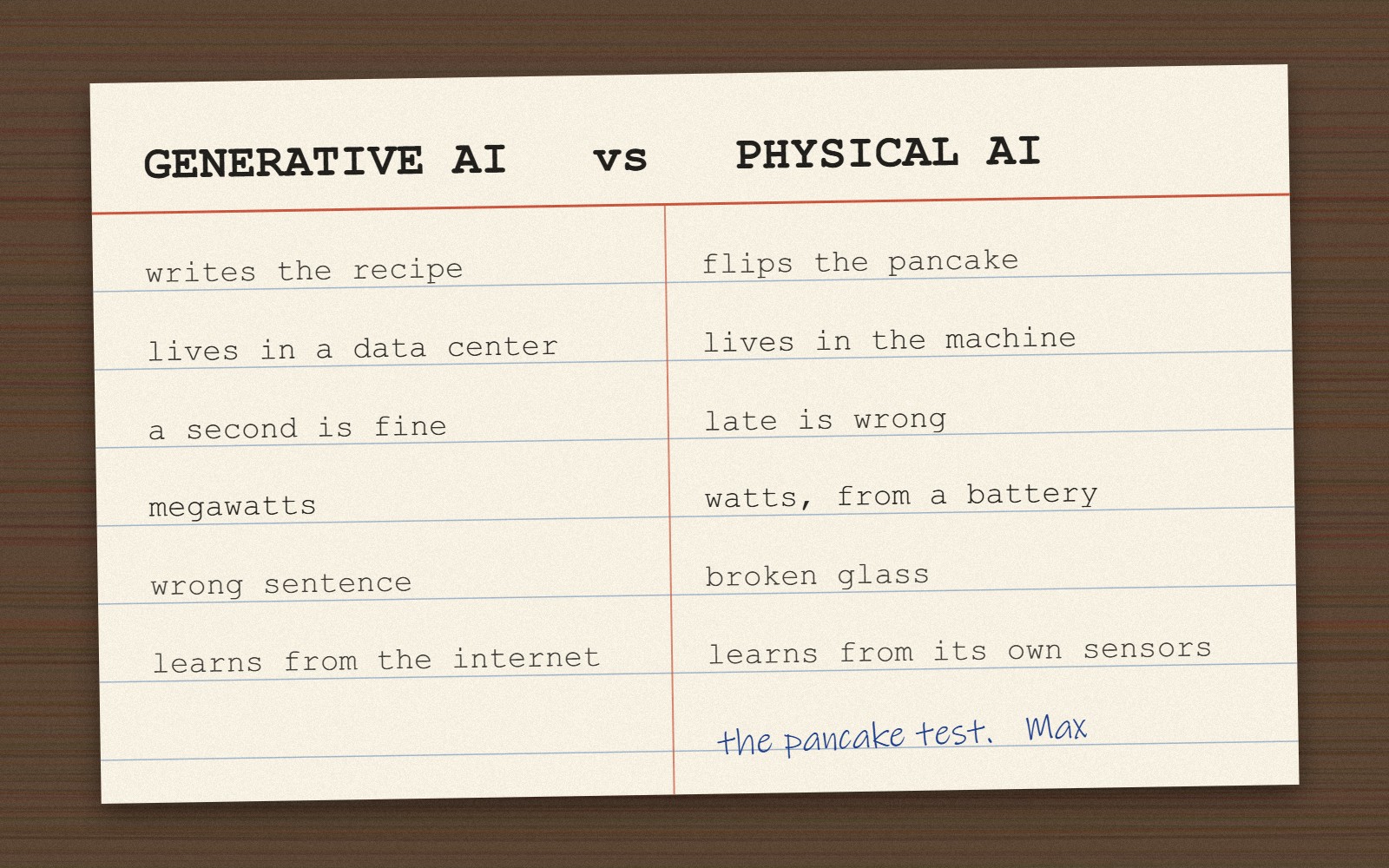
| Generative AI | Physical AI | |
|---|---|---|
| What it produces | Text, images, code | Movement and decisions in the real world |
| Where it runs | Mostly in data centers | On the machine, next to the sensors |
| Its clock | A second or two is fine | Milliseconds. Late is wrong |
| Its energy | Megawatts, somewhere else | Watts, from a battery |
| Cost of a mistake | A wrong sentence. You ask again | A broken glass, or worse |
| What it learns from | Text and images from the internet | Its own sensors and its own actions |
| Where you meet it | Chatbots, image generators, coding assistants | Robots, drones, vehicles, industrial machines |
Where the two meet
They are not rivals. Vision-language-action models take the language ability of generative AI and wire it to motors: “put the cup on the shelf” goes in, arm movements come out. Generative models also build simulated worlds where robots can practice before they touch anything real (see Sim2Real and world model).
So the talking part and the doing part are getting closer. The hard limits stay on the doing side: latency, power, memory, and a world that does not wait.
And embodied AI? Robotics?
Embodied AI is the older, academic name for more or less the same idea. Robotics is the machine itself: motors, joints, control. Physical AI is the intelligence inside it… plus a wider family of machines that sense and act without looking anything like a robot.
Why the brain keeps coming up
A brain runs on about twenty watts. It predicts, checks, corrects, and learns while it works. No data center, no retraining weekend.
That is the spec Physical AI is chasing. I have spent 25 years on it, and the brain is still ahead.
Quick answers
Is Physical AI the same as generative AI?
No. Generative AI produces content: text, images, code. Physical AI produces behavior: it senses, decides and moves a machine in the real world, on time and on a power budget.
Is a humanoid robot generative AI or Physical AI?
Physical AI. It may use a generative model to understand an instruction, but its job is to act in the world, and that is where the hard limits are.
Can generative AI run a robot?
Partly. Vision-language-action models connect the language ability of generative AI to motors. The robot still needs fast, low-power perception and control on board, because a late answer is a wrong answer.
Which one is harder?
Different kinds of hard. Writing a sonnet turned out to be easier for machines than folding a shirt. Almost nobody saw that coming, except maybe the roboticists.