

In 2007 I defended a PhD thesis at Boston University with a title only a neuroscientist could love: Laminar Circuits for Synchronous Thalamocortical Information Processing and Attentive Stable Learning by Spiking Neurons. Try saying that at a dinner party.
For years, ideas like these sat on the shelf next to other things the AI world had decided it did not need: spikes, local learning rules, brain-inspired chips. Deep learning was winning, data centers kept growing, and backpropagation was the answer to every question.
Then machines started leaving the data center.
Physical AI changes the question
A robot in a warehouse, a drone over a field, a camera on a factory line: they live on a power budget, they have milliseconds to react, and they keep running into things nobody showed them during training.
Today’s recipe is simple. Train a huge model with backpropagation in the cloud, freeze it, ship it, and retrain it in the cloud when the world changes. That works fine for a chatbot. For a machine with a body, it is slow, expensive and often impossible.
What Physical AI needs is close to what the cortex has been doing for a very long time: algorithms that are light, that never stop learning, and that run on hardware that spends energy only when something actually happens.
What laminar circuits taught us
Start with a simple fact: the brain is a prediction machine. It does not sit and wait for the world to tell it what is out there. It keeps sending its best guess down toward the senses, all the time. The wiring agrees: in the loop between cortex and thalamus, the feedback fibers coming down outnumber the feedforward ones going up by roughly ten to one.
The cortex is not a uniform sheet of neurons. It is built in layers, and each layer has a job. Stephen Grossberg and colleagues built a family of laminar models, called LAMINART, to explain how these layers handle vision, attention and learning. In my thesis, and in a 2008 Brain Research paper with Steve, we pushed that work further into SMART, Synchronous Matching Adaptive Resonance Theory, with spiking neurons, the thalamus, and the rhythms that tie them together.
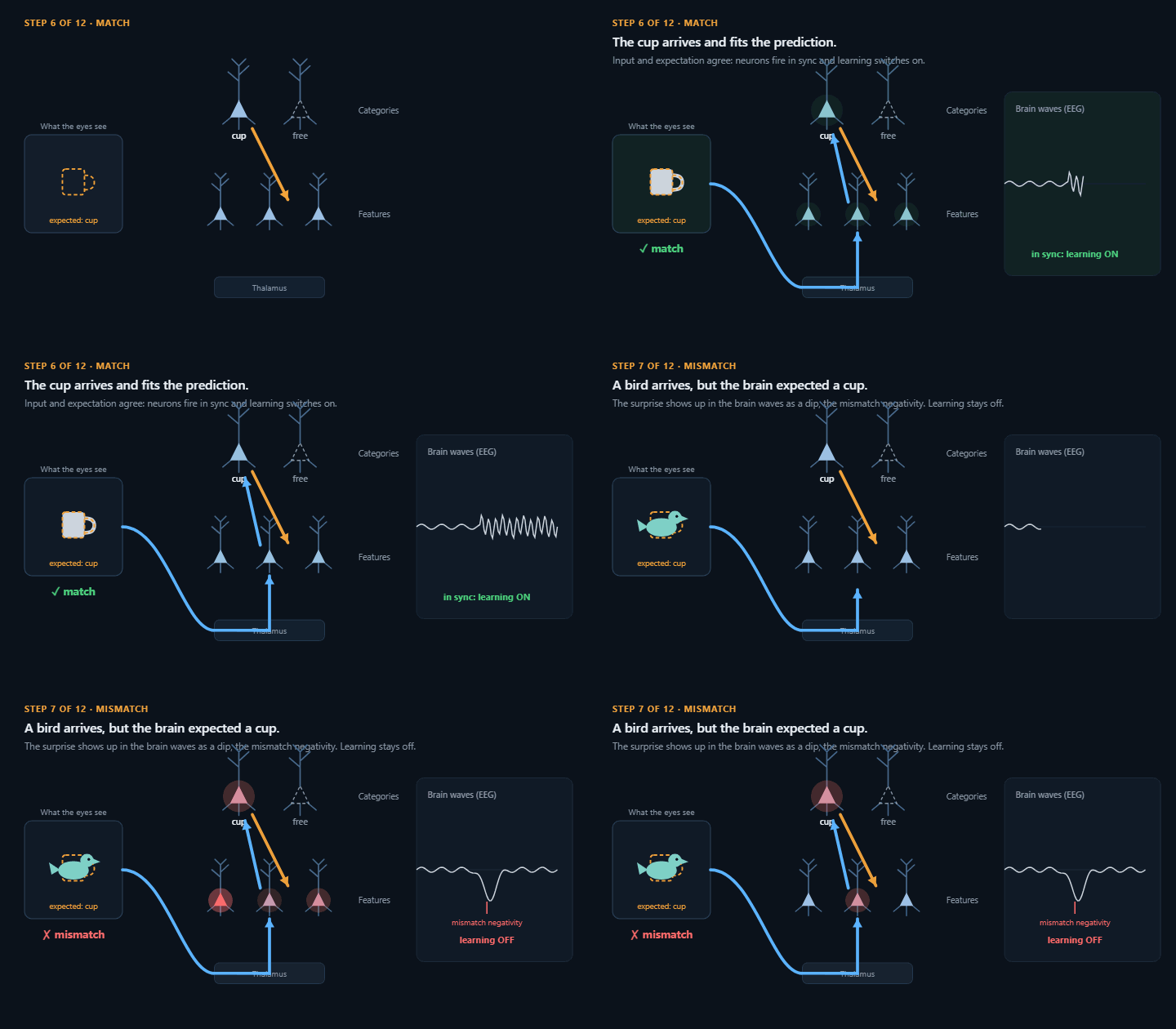
Here is the whole loop, step by step, with a concrete example: a cup, a bird, a deep network and a robot. It plays on its own, or use the buttons to go at your own pace.
Every input travels bottom-up, from the senses. At the same time, the brain sends a top-down expectation: its best guess of what it is looking at.
- Match. When input and expectation agree, the circuit resonates. Neurons fire in sync at gamma frequencies, and only then does spike-timing-dependent plasticity (STDP) switch on and refine the memory.
- Mismatch. When they disagree, the rhythm drops to beta and learning stays off. The nonspecific thalamus fires a reset that shuts down the wrong guess, and the search moves on until it finds a better category, or a free one that learns the new pattern on the spot. In EEG recordings, this kind of surprise shows up as a mismatch negativity, a dip in the brain waves a fraction of a second after the unexpected input.
- Vigilance. How close the match has to be is set by acetylcholine. Higher vigilance, finer categories.
The result is a system that learns fast, learns locally, and keeps what it already knows. No global error signal. No backpropagation. No catastrophic forgetting. The brain solved this one a long time ago… we just took a while to notice.
The same loop maps neatly onto a deep network. Features flow up through the layers, predictions flow back down, and a new class gets its own node instead of overwriting the old ones. That is the idea behind the lifelong learning networks we later put into drones, phones, cameras and robots: they learn on the device, one example at a time.
Local rules, spikes and silicon
There is a reason I care so much about the word “local.” In 2005, Anatoli Gorchetchnikov, Michael Hasselmo and I published a model of STDP that uses only information available at the synapse, in space and in time. A synapse that learns from what happens right next to it is a synapse you can build in hardware, without shipping error signals across a chip.
We also needed a way to simulate all this, so we built KInNeSS, a modular framework for spiking neural models. And because those simulations crawled on regular processors, we started running them on graphics cards. That work, with a 2006 priority date, became a US patent on a GPU-based accelerator. Yes, GPUs for neural networks, before it was cool.
Then came DARPA’s SyNAPSE program. With HP Labs we explored memristors, tiny devices that store and compute in the same place, a bit like synapses do. We wrote down a general form of learning rules for neuromorphic hardware, built MoNETA (“a mind made from memristors”, an IEEE Spectrum cover story in 2010), and described the full stack from synapses to circuitry in an IEEE Computer cover feature in 2011.
The science was the easy part
Getting from equations to products took far longer than the science. The same brain-inspired, learn-on-the-fly ideas went to NASA for Mars rover research, then into drones, phones, cameras and factory lines. NASA tells that story in From Mars Rovers to Factory Assembly Lines, and in 2026 the Space Foundation inducted the technology into the Space Technology Hall of Fame, deployed in roughly 80 million devices and systems.
Years of trial, error and persistence. Mostly persistence.
Why now
For most of the last 20 years, the pieces never lined up. The algorithms existed, but the hardware did not. Then the hardware started to show up, but the market was not ready.
Today the three are finally meeting: lightweight algorithms that keep learning; spiking and in-memory hardware that is efficient by nature, because it computes only when something changes; and a real market in Edge AI, robotics and Physical AI that needs both. That convergence is what I work on today at Analog Devices.
Machines that adapt and compute continuously, the way brains do, are no longer a thesis title. They are an engineering plan.
Still hard to say at a dinner party, though.
Further reading
- Versace, M. (2007). Laminar Circuits for Synchronous Thalamocortical Information Processing and Attentive Stable Learning by Spiking Neurons. PhD thesis, Boston University (related technical report).
- Gorchetchnikov, A., Versace, M., & Hasselmo, M. (2005). A model of STDP based on spatially and temporally local information. Neural Networks.
- Grossberg, S., & Versace, M. (2008). Spikes, synchrony, and attentive learning by laminar thalamocortical circuits. Brain Research.
- Versace, M., et al. (2008). KInNeSS: a modular framework for computational neuroscience.
- Versace, M., et al. Graphic processor based accelerator system and method. US Patent 8,648,867 (2006 priority).
- Gorchetchnikov, A., Versace, M., et al. (2010). General form of learning algorithms for neuromorphic hardware implementation. BMC Neuroscience.
- Versace, M., & Chandler, B. (2010). MoNETA: a mind made from memristors. IEEE Spectrum.
- Snider, G., Versace, M., et al. (2011). From synapses to circuitry: using memristive memory to explore the electronic brain. IEEE Computer.
- Gorchetchnikov, A., Versace, M., et al. (2011). MoNETA: massive parallel application of biological models. BMC Neuroscience.
- NASA Spinoff: From Mars Rovers to Factory Assembly Lines.
- Neurala Brain inducted into the 2026 Space Technology Hall of Fame.
I keep everything on Physical AI in one place, from papers and patents to 15 years of press: Physical AI.
More on this: Forget Catastrophic Forgetting: the path to Deep Learning at the Edge · Bringing Brain-Inspired Computing to Life with Cog Ex Machina