
I get asked for numbers a lot, usually ten minutes before somebody’s talk. Here are the ones I trust, each with its source. I will add to the list as better ones turn up.
Last updated: 12 November 2026.
The brain
| Number | What it is | Source |
|---|---|---|
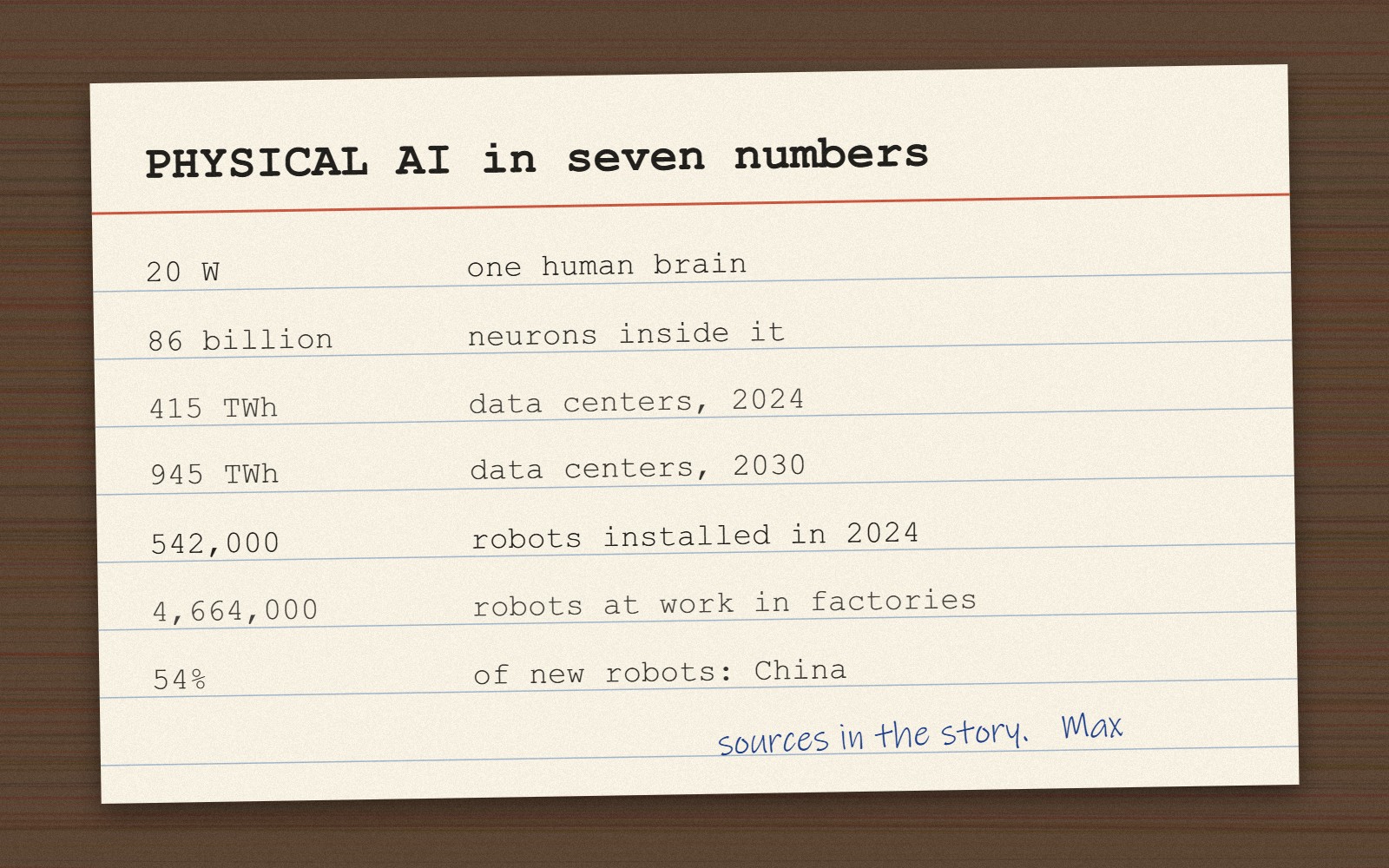
| About 20 watts | The energy budget of the human brain. The same paper notes that the computer it was typed on needed 80 watts. | Balasubramanian, “Brain power”, PNAS, 2021 |
| 86 billion | Neurons in the human brain, with about as many non-neuronal cells. | Herculano-Houzel, PNAS, 2012 |
The data center
| Number | What it is | Source |
|---|---|---|
| 415 TWh | Electricity used by data centres worldwide in 2024, about 1.5% of global consumption. | IEA, Energy and AI, 2025 |
| About 945 TWh | Projected data centre consumption in 2030: more than double. | IEA, Energy and AI, 2025 |
The robots
| Number | What it is | Source |
|---|---|---|
| 542,000 | Industrial robots installed worldwide in 2024. | IFR, World Robotics 2025 |
| 4,664,000 | Industrial robots operating in factories worldwide in 2024, up 9% on the year before. | IFR, World Robotics 2025 |
| 54% | China’s share of the robots installed in 2024. | IFR, World Robotics 2025 |
What I read in these numbers
One brain: 20 watts, and it catches the glass. The world’s data centers: 415 terawatt-hours a year and climbing.
Millions of machines out in the field cannot carry that kind of power around. They run on batteries, they have milliseconds to decide, and nobody is there to hit “retry”. That gap is why Physical AI needs its own kind of computing… and why I keep going back to biology for ideas.
Using these numbers
Quote freely. Please cite the original source next to each number; a link back to this page is appreciated. If you know a better or newer figure, tell me.
The numbers on this page are also available as a plain file, with sources: physical-ai-in-numbers.csv.