

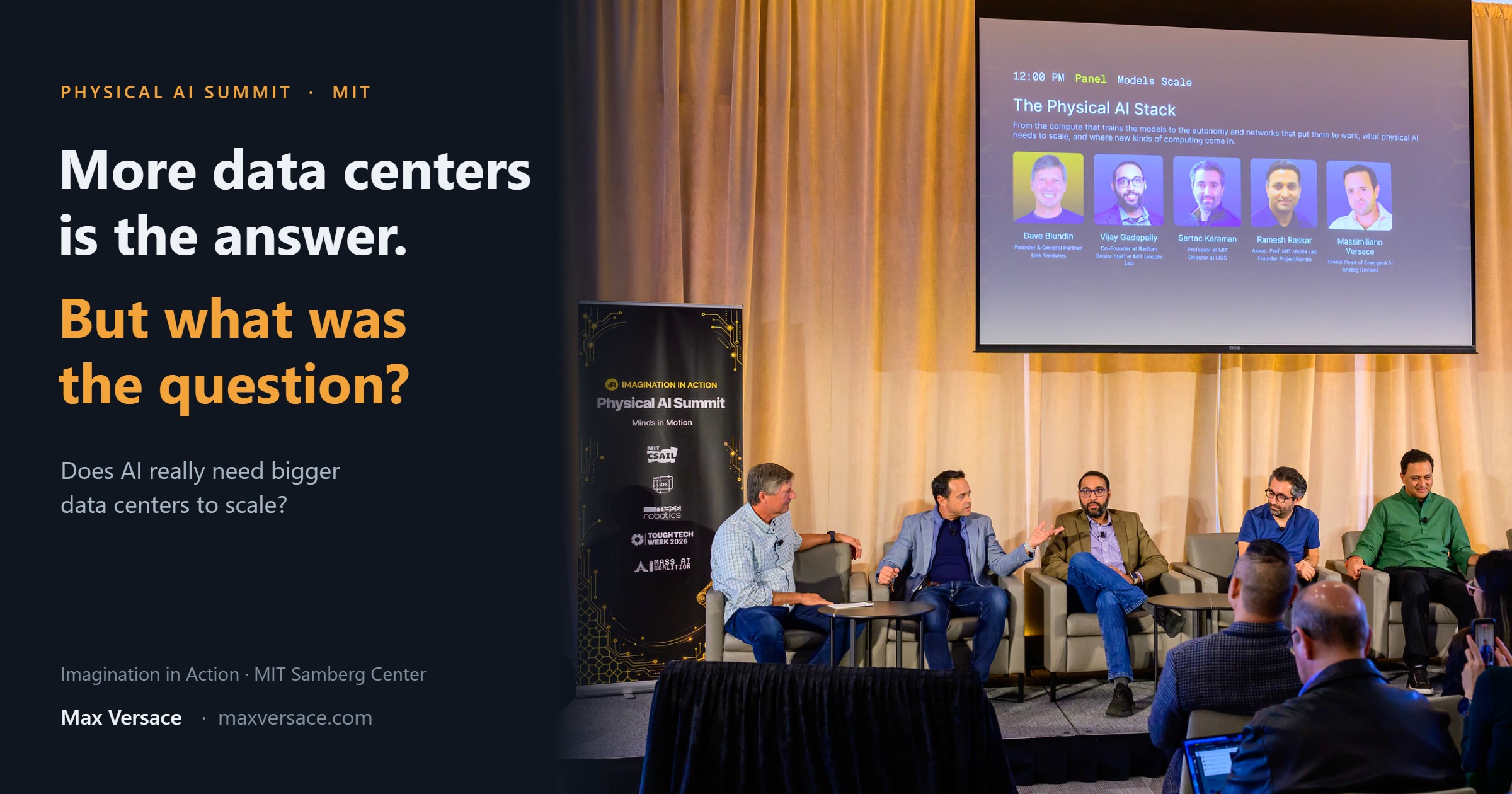
More AI data centers is the answer! But what was the question?
Lately every conversation about AI seems to end in the same place: more GPUs, more power plants, more buildings full of servers. That may well be the right answer for training very large models. It is the wrong answer for a robot.
That was the topic of our panel at the first Imagination in Action Physical AI Summit at MIT, with Vijay Gadepally, Sertac Karaman, Ramesh Raskar and our moderator Dave Blundin. The full session, Does AI Really Need Bigger Data Centers to Scale?, is now online:
A robot cannot wait for the cloud
A data center lives in a world of plenty: power from the grid, industrial cooling, and all the time it needs to think. A robot lives in a very different world. It has a battery, a few milliseconds to react, noisy sensors, people walking by, and physics that does not care how many parameters your model has.
A humanoid that has to call home before deciding whether to catch a falling glass will spend most of its career sweeping up broken glass.
Power, latency, sensing, safety: these are not details you fix later. They are the spec. And they do not get better by building a bigger data center a few hundred miles away.
Put the compute next to the sensors
So getting robots out of the lab and into the world calls for a different kind of computing, not just more of the same. Far more efficient, sitting at the edge, and tightly connected to sensing and control.
Biology figured this out a long time ago. A lot of the fast work in an animal happens close to the eyes and the muscles: reflexes, balance, early filtering of what the eyes see. The cortex gets the hard problems. The whole human brain runs on about 20 watts… less than an old light bulb, and a small fraction of a single data center GPU.
This is the work we are doing at Analog Devices: computing that lives close to the sensors and the motors, so machines can gain real physical skills, from autonomy to dexterous manipulation to reasoning at the edge, while staying reliable, safe and transparent about what they do.
Data centers are not going away
To be clear, I have nothing against data centers. Large models will keep being trained there, and robots will keep learning from them. But the moment a machine has to act in the physical world, the question changes. It is no longer “how much compute can we build?” It becomes “how much intelligence can we fit in this power budget, right here, right now?”
That is a much harder question. It is also a lot more fun.
Thanks to Imagination in Action and John Werner for bringing the Physical AI community together at MIT, and to Vijay, Sertac, Ramesh and Dave for a sharp and very enjoyable discussion. More notes and photos from the day are in Brains, Not Bodies: Notes From the Physical AI Summit at MIT.
I keep everything on Physical AI in one place, from papers and patents to 15 years of press: Physical AI.
More on this: One AI model isn’t enough? Stack a Cascade of brains! · Cloud vs Edge: an Industrial Manufacturing dilemma