

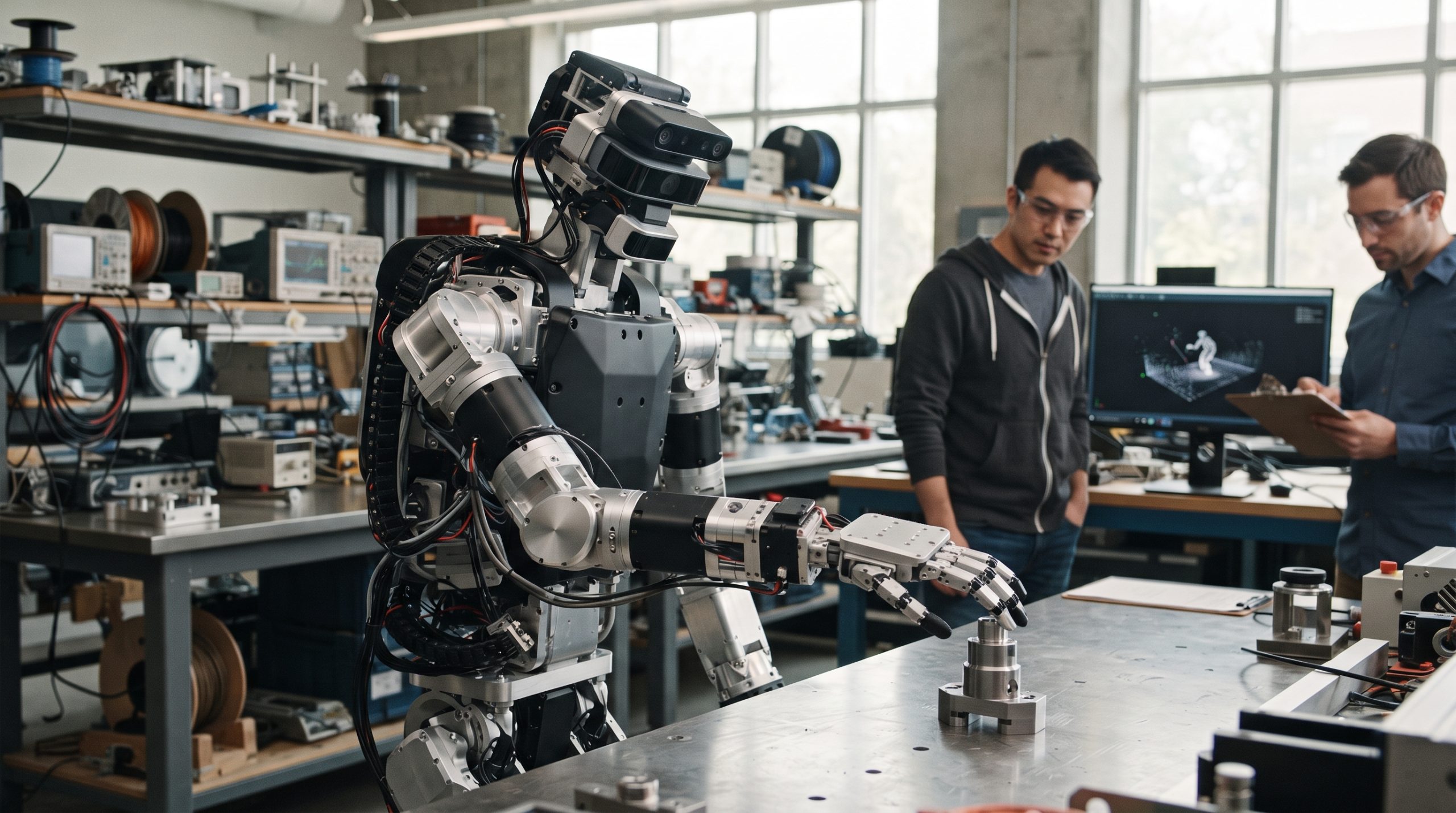
For much of the history of artificial intelligence, we have had the luxury of treating intelligence as if it existed somewhat independently from the physical world. A model could classify an image, recognize speech, predict a sequence or, more recently, generate remarkably sophisticated language while operating inside a computational environment whose relationship with the outside world was mostly somebody else’s problem. The model received an input, transformed it and produced an output, and although latency, energy consumption and reliability certainly mattered, the consequences of getting something slightly wrong were usually mediated by another layer of software, another human decision or simply the fact that nothing physical happened as a result. Robotics changes this relationship in a rather fundamental way because, once intelligence acquires a body, the world stops behaving like a dataset and begins behaving like the world: objects have mass, surfaces have friction, motors have torque limits, batteries become depleted, sensors disagree with one another, lighting changes, humans move unpredictably, and a decision that would have been an amusing hallucination in a chatbot can become a considerably less amusing event when a machine is moving through a warehouse or manipulating an object near a person.
I have been interested in this boundary between intelligence and physical systems for most of my professional life, although the vocabulary used to describe it has changed several times along the way. Long before expressions such as Physical AI, embodied intelligence or robotics foundation models became common, work in computational neuroscience, neuromorphic computing and autonomous systems was already forcing us to ask how perception, memory, learning and action should interact when computation is constrained and when the system cannot assume that a large remote server will eventually resolve every uncertainty. In autonomous environments, and particularly in systems where communication may be delayed, intermittent or simply unavailable, intelligence has to reside much closer to the machine because waiting for the cloud is not an architectural option. What I find especially interesting today is that robotics is bringing many of these questions back to the center of AI, except that we now have much more powerful models, vastly larger amounts of compute and commercial ambitions that extend well beyond the relatively specialized autonomous systems of the past.
Intelligence inside a robot will probably not be one thing
One assumption that I increasingly find questionable is the idea that the intelligence of a robot should eventually collapse into one homogeneous model. Biology gives us very little reason to believe that this is the only, or even the most natural, architecture. When I touch something hot, parts of my nervous system begin responding before I have finished constructing a conscious interpretation of what has happened; when I walk, a remarkable amount of sensory and motor computation takes place without my reasoning explicitly about the position of each muscle, while at the same time I can decide where I am going, recognize somebody approaching me, remember an appointment later in the day and reconsider my route because I have suddenly decided that an espresso would improve the situation. We describe all of these activities loosely as intelligence, but they occur at very different timescales, depend on different kinds of representation and place very different demands on the underlying biological machinery.
I suspect useful robots will develop in a similarly heterogeneous direction. A large multimodal model may provide semantic understanding, interpret an instruction, reason about a scene and formulate a plan, while another part of the system performs visual-motor control at frequencies where large-scale deliberative reasoning would simply be too slow. Other components may estimate state, fuse information arriving from cameras, encoders and inertial sensors, enforce safety constraints, respond to contact with the environment or maintain control stability while the high-level system is still deciding what it wants to do. Some of this computation can tolerate hundreds of milliseconds and some of it cannot tolerate tens of milliseconds, and pretending that these are merely different instances of the same computational problem may ultimately prove less elegant than it first appears.
This is one reason I find the emergence of vision-language-action models particularly interesting. They are beginning to connect perception, linguistic understanding and action in ways that historically belonged to different parts of the robotics stack, but the real architectural question is not simply whether those layers can be unified; it is which ones should be unified, how tightly, and under what physical and computational constraints. AI has a recurring tendency to assume that sufficiently large models will eventually make different engineering disciplines disappear into a single abstraction, whereas the physical world has an equally persistent tendency to reintroduce all the inconvenient details that the abstraction was designed to hide.
Embodiment changes what learning actually means
A model trained primarily on language or images learns from representations of the world that humans have already created and organized. A robot receives something much less convenient: the world itself, continuously and without the courtesy of clean segmentation. Cameras produce streams of images, proprioceptive sensors report how the body is moving, encoders describe joint positions, force sensors reveal contact, inertial sensors measure motion, microphones capture acoustic information, and all of these signals arrive while the machine is actively modifying the environment that generated them. The robot perceives, acts, observes the consequences of its own action and then has to decide what to do next, which means that its outputs become part of its future inputs and that perception and action can no longer be treated as separate episodes connected only by a convenient software interface.
There is nothing conceptually new about this formulation for anyone coming from robotics or control theory, but what is new is the sophistication of the learned models that are now being inserted into the loop. A model may understand perfectly well that there is a cup on a table, but controlling a hand so that it approaches the cup, compensates for uncertainty in the estimated position, generates the correct grip force and avoids disturbing the objects around it requires a relationship with the environment that is very different from merely recognizing that the cup exists. Physical intelligence therefore forces us to reconnect semantic understanding with geometry, dynamics, timing and uncertainty, and to recognize that a robot does not experience the world as a succession of prompts but as a continuous process in which its own actions alter what it will perceive next.
This also makes the boundary between reasoning and control unusually important. One can imagine a hierarchy in which a high-level system decides that the robot should pick up the red cup while lower-level policies determine trajectories, joint commands and force limits, or one can imagine architectures in which learned systems generate continuous actions much more directly. Between these two extremes there is a very large design space, and I suspect that the most successful systems will be determined less by ideological attachment to one architecture than by the practical question of where abstraction helps and where it becomes expensive. A high-level reasoning model may be enormously capable but relatively slow and computationally demanding, while a motor-control loop has to be fast, predictable and usually local; asking the same system to solve both problems may be conceptually attractive and engineering-wise rather inconvenient. Separating the stack too aggressively, however, creates the opposite problem, because the higher-level intelligence may then have an impoverished understanding of the physical consequences of its own decisions.
This tension reminds me of many of the discussions that surrounded neuromorphic computing and Edge AI over the years. The algorithm and the machine implementing it can be separated conceptually, but only up to a point, because timing, locality, memory organization, communication and energy consumption eventually influence what the system can do efficiently. Robotics extends that principle beyond the processor because the computational architecture is now coupled to a mechanical architecture as well. The body ceases to be a peripheral and becomes part of the intelligence problem.
Robotics has a different data problem
Large language models benefited from a historical circumstance that, in retrospect, was extraordinarily fortunate: humanity spent decades creating enormous amounts of digital information before anyone knew that much of it would eventually become training data for AI. Robotics does not inherit an equivalent internet of motor experience. There are billions of images and videos showing people interacting with the physical world, and these will certainly be useful, but video alone does not tell us everything that matters when contact occurs. It does not directly encode the force applied by a hand, the torque required at a joint, the friction of a surface, the deformation of an object or the subtle sequence of corrections that allows a manipulation to succeed.
This means that robotic learning will require a much tighter connection between deployment and training. Every robot operating in the world can potentially become a source of new experience, and every successful manipulation, unexpected failure, unusual environment or human intervention can contribute information that improves future behavior. The possibility is powerful because deployment can generate data, data can improve the models and improved models can enable broader deployment, but the circularity of the argument is also obvious: a robot that is not sufficiently capable cannot be deployed widely enough to collect useful experience, while a model without sufficient real-world experience may never become capable enough to justify broad deployment. Simulation, teleoperation, human demonstration, synthetic data and transfer between different robot embodiments will all probably contribute to breaking this cycle, but the long-term advantage may belong to systems that learn not only before they are deployed, but while they are operating.
That question has interested me for a long time because continual learning becomes much more compelling once the machine has a physical life. Humans do not experience a clean distinction between training and deployment; we learn while working, moving, making mistakes, talking to other people and encountering circumstances that were absent from anything resembling a training set. A robot operating for years in a changing environment will eventually need some version of this capability, but implementing it responsibly is much harder than simply allowing the model to update itself. The system must decide which experiences are trustworthy enough to learn from, how new knowledge should interact with old knowledge, how to avoid catastrophic forgetting and how to prevent one anomalous experience from degrading behavior that was already reliable.
The problem becomes even more interesting when we move from one robot to fleets of robots. A population of machines operating in different factories, warehouses or homes may collectively encounter an enormous range of situations that no individual system would ever experience on its own. Some of that learning should presumably be shared, while some should remain local because environments, users and even individual machines differ. If we eventually build robots that accumulate experience over years, then the representation, validation and transfer of that experience may become one of the most important assets in the entire robotics platform. A robot that has worked for five years should, in some meaningful sense, know something that a robot manufactured yesterday does not.
Physical AI will redistribute computation
Robotics also challenges the idea that intelligence should reside in one computational location. Training large models will continue to depend on centralized infrastructure at enormous scale, but the machine operating in the physical world lives under a different set of constraints. Certain decisions cannot tolerate network latency, certain sensory information should remain local, communication may be unavailable, power and thermal budgets matter, and if robots are eventually manufactured in large numbers the cost of computation inside every unit becomes part of the economics of the product rather than an abstract infrastructure expense.
The likely result is a more distributed architecture in which large-scale training occurs centrally, some forms of high-level reasoning may use remote resources when available, while perception, immediate control, safety and at least some forms of adaptation increasingly occur on the machine itself. Specialized processors may handle vision, sensor fusion or control more efficiently than a single general-purpose accelerator attempting to perform every workload, and this is where Physical AI reconnects rather naturally with semiconductor architecture and hardware/software co-design. During Neurala’s history, as we worked across embedded systems and with semiconductor companies and computing platforms, the same lesson emerged repeatedly: once intelligence becomes part of a physical product, the computing substrate stops being an implementation detail and becomes part of the product architecture. Memory affects cost, power affects battery life and thermal design, latency affects behavior, and processor choice constrains the markets the system can realistically enter. Eventually, the economics of intelligence become the economics of the machine.
There is also the less glamorous but absolutely central issue of uncertainty. A robot rarely sees the world under perfectly controlled conditions: sensors are noisy, objects are occluded, lighting changes, floors can be slippery, humans move unexpectedly, materials deform, transparent objects confuse vision systems and novel situations occur with irritating regularity. A physical system therefore needs some understanding not only of what it believes, but of how much confidence it should assign to that belief. This is not simply a question of calibration at the model level; it is a behavioral problem. A robot that recognizes uncertainty can slow down, change its viewpoint, collect additional information, choose a safer action or ask for assistance, whereas a system that extrapolates confidently beyond its experience can convert a relatively small model error into a rather expensive physical event. As robots move out of tightly structured industrial settings and into environments designed primarily for humans, this ability to distinguish the familiar from the genuinely uncertain will become increasingly important.
Physical AI remains a systems problem
Robotics has always been a systems discipline because useful machines require perception, planning, control, mechanical engineering, electronics and software to work together, and I do not think foundation models will eliminate that systems character. If anything, they make it more interesting because they introduce a new and remarkably capable layer into an already complicated physical stack. The learned model still has to receive information from sensors whose characteristics matter, execute on processors with finite power and memory, act through motors and actuators with physical limitations, and behave predictably enough that somebody is willing to deploy the machine near people, equipment and processes that have actual economic value.
For this reason, I suspect that the most interesting progress in Physical AI will come from organizations capable of moving comfortably across boundaries that have traditionally separated machine learning, robotics, controls, embedded computing and semiconductor design. The important questions will not be confined to whether a foundation model can understand an instruction or whether a robot can execute a demonstration in a laboratory; they will involve how intelligence is partitioned across the system, what must happen locally, what can happen remotely, how experience is accumulated, how uncertainty is represented, how the architecture scales economically and how all of these choices interact with the physical design of the machine.
I find this convergence particularly compelling because much of my own career has unfolded inside these boundaries, from computational neuroscience and neuromorphic computing to autonomous systems, Edge AI, semiconductor collaboration and industrial deployment. The terminology has changed repeatedly, and each generation has introduced its preferred vocabulary, but the underlying challenge has remained surprisingly stable: how do we build intelligence that continues to work once it leaves the controlled environment of the computer and becomes part of a physical system that has to operate continuously, economically and safely in the real world?
Robotics may turn out to be the domain in which many of the separate threads of modern AI are finally forced to interact in a serious way, because a machine that perceives, reasons and acts cannot indefinitely separate the quality of its model from the characteristics of its sensors, its compute, its body and the environment in which it operates. That is what makes Physical AI interesting to me. It is not simply the addition of robotics to artificial intelligence; it is the return of intelligence to a setting in which the architecture of the entire system matters again, and where some of the most important innovations may emerge precisely from the uncomfortable boundaries between disciplines that have spent the last few decades learning to speak somewhat different languages.
Read more about Max Versace