

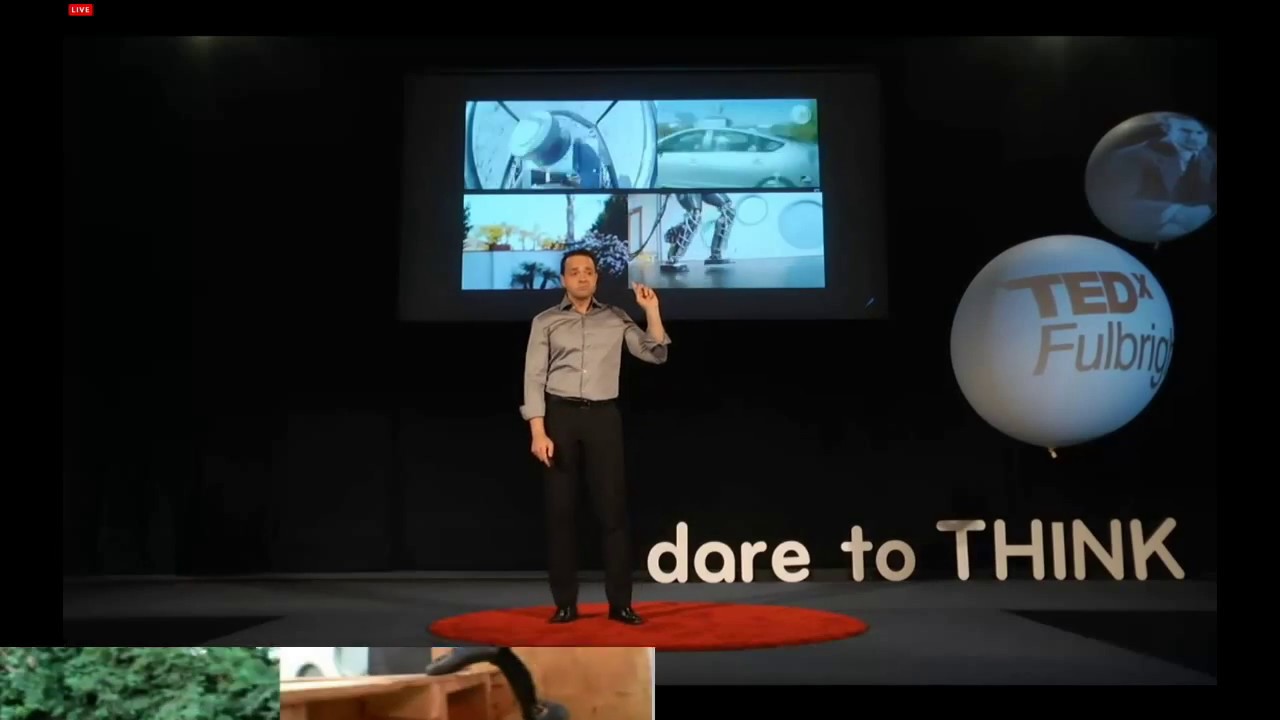
If aliens learned about Earth only from YouTube, they would think the planet is run by robots. Walking robots, flying robots, cow-shaped robots…
The truth is that most of those robots are still stuck on YouTube. That was my opening at TEDxFulbright in Washington. To get them out and into everyday life, three things have to arrive together. I call them body, mind and brain.
Body
Affordable robotic bodies that can be mass-produced. This is where the good news is. A robot I would have paid thousands of dollars for a few years ago now costs a fraction of that, largely because sensors got cheap. Cameras, microphones, gyros, GPS: every smartphone sold brings the price down. Buy a phone, lower the cost of a robot.
Mind
The algorithms that turn a body into behavior. A remote-controlled robot defeats the purpose: you want one person and a fleet, not one person per machine.
I come from neuroscience, so I am biased, but I believe the biological brain is the right model. It gets its power from two simple ingredients: learning and parallel processing. In our lab we built a large-scale brain model for a robot, and with NASA we used it to let a rover-like robot explore a simulated Mars, recognize rocks and find its way back to base without GPS.
One lesson from that work. Your eye sees sharply only in a patch about the size of your thumbnail at arm’s length. Try it: hold out your thumb, look at it, and try to read something a few degrees to the side. If the whole retina were that sharp, the brain needed to process it would weigh 10,000 pounds. Biology spends its resources where they matter. Robots should too.
Brain
The hardware. The human brain fits in two liters and runs on the power of a light bulb. Nothing we build comes close yet.
But processors are moving in the right direction: more cores working in parallel, graphics chips with a lot of computing power, and the first neural processing units designed to learn the way brains do. When people ask what you can do with a thousand processors in your phone, the answer is… run a brain.
What is left
Body, mind and brain are converging, and I believe we can now build robots that leave YouTube. The open problem is how to bring them into society in the right way. That one needs the best minds we have.
Watch the talk
I keep everything on Physical AI in one place, from papers and patents to 15 years of press: Physical AI.